Canada remains one of the most popular study destinations for Indian students, but the rules have changed more in the last two years than in the previous decade: a national cap on study permits, a new provincial attestation letter, higher proof-of-funds amounts and the end of the Student Direct Stream. This guide puts the current rules in one place. Every figure below is from official Government of Canada pages, checked on 16 November 2026.
The fee: CAD 150, plus biometrics
The study permit application fee is CAD 150 per person. On top of that, Indian applicants must give biometrics (fingerprints and a photo), which costs CAD 85 for an individual, capped at CAD 170 for a family applying together. Budget for both when you apply online. Book your biometrics appointment as soon as you get the instruction letter - IRCC explicitly warns that waiting for it causes processing delays.
Proof of funds: CAD 23,448 a year for a single student
Canada raised its proof-of-funds requirement again for applications submitted on or after 1 September 2026. You must now show money for living expenses of CAD 23,448 a year for a single applicant - and this is on top of your first-year tuition and travel costs, which you must also cover. The amounts are updated every year, so check the official page for the figure that applies on the day you submit.
| Number of family members (including you) | Living expenses required per year |
|---|---|
| 1 | CAD 23,448 |
| 2 | CAD 29,192 |
| 3 | CAD 35,888 |
| 4 | CAD 43,572 |
The official chart continues for larger families - see the canada.ca link in the sources if you are applying with dependants. Two more points that matter: you must show you can pay for your first year of studies plus living costs, and show a credible plan for funding the full duration of your program. And if you are headed to a school in Quebec, different rules apply - you need a Quebec Acceptance Certificate (CAQ) and follow Quebec's own financial requirements.
The student cap and the PAL/TAL letter
Since 2024, Canada runs a national cap on study permits. For 2026 the target is up to 408,000 permits - 155,000 for newly arriving students and 253,000 for extensions - which is 7% below the 2025 target of 437,000. The number of study permit holders in Canada has already fallen from over 1 million in January 2024 to about 725,000 by September 2025.
The cap works through a new document: most applicants must include a provincial attestation letter (PAL) or territorial attestation letter (TAL) with their application. You do not apply for it yourself - your school (the designated learning institution, or DLI) gets it from the province, usually after you accept your offer and pay some or all of your tuition. Each applicant needs their own letter, and PALs issued for the 2026 cap year are valid until 31 December 2026.
Who does not need a PAL matters just as much. Under the exemptions in force for 2026: students applying for master's or doctoral programs at public DLIs (new from 1 January 2026), kindergarten to grade 12 students, certain Government of Canada priority groups and vulnerable cohorts, and existing permit holders extending at the same DLI and level of study. If you are going for a master's or PhD at a public university, this is a real simplification - for everyone else, plan your timeline around the school issuing your PAL.
SDS is closed - everyone uses the regular stream
If an agent or an older blog post tells you to apply through the Student Direct Stream (SDS), that information is out of date. IRCC ended SDS on 8 November 2024, along with the Nigeria Student Express. Every application submitted since then - including from India - goes through the regular study permit stream, with the same document requirements for all countries. A Guaranteed Investment Certificate (GIC) is still accepted as proof of financial support, but there is no longer a faster lane attached to it.
Processing time from India: 8 weeks
IRCC's own processing times tool currently shows 8 weeks for a study permit application from India. Treat that as an estimate, not a promise - IRCC states these times are not a maximum or a guarantee, and your application can take longer if it is incomplete or needs extra checks. The figure updates regularly, so check the tool again in the week you apply. The clock effectively depends on you too: apply early (at least four to six months before your program starts), give biometrics quickly, and answer any IRCC request for documents without delay.
Working while you study: 24 hours a week
If your program is at least six months long and leads to a degree, diploma or certificate, you can usually work off campus up to 24 hours per week while classes are in session and full-time during scheduled breaks like summer or winter holidays. The condition is printed right on the permit. You will also need a Social Insurance Number (SIN) to work in Canada. What you cannot do is work before your studies begin - and the 24-hour cap is a hard limit, not an average.
How to apply from India, step by step
1. Get your letter of acceptance. Apply to and be accepted by a school on IRCC's list of designated learning institutions - only a DLI's acceptance letter supports a study permit.
2. Get your PAL/TAL through the school. Unless you are exempt (master's/PhD at a public DLI, K-12, or an extension at the same school and level), the DLI obtains your provincial attestation letter - usually after you accept the offer and pay tuition in part or in full.
3. Gather your documents. The checklist below covers the standard set.
4. Apply online. Create an account on the IRCC portal, complete the application, upload documents and pay the CAD 150 fee plus the CAD 85 biometrics fee.
5. Give biometrics. You will get an instruction letter; book the collection appointment quickly to avoid delays.
6. Wait for the decision. Currently about 8 weeks from India. If approved, you receive a port of entry letter of introduction - this is not your study permit - and, because India is a visa-required country, a visitor visa (TRV) placed in your passport so you can travel. Show the letter to the border officer when you land in Canada, and the officer issues your actual study permit there. You must enter Canada before your visa expires.
Documents checklist
- Letter of acceptance from a designated learning institution.
- Provincial or territorial attestation letter (PAL/TAL) - unless you are in an exempt category.
- Passport and two recent photos meeting the visa photo requirements.
- Proof of financial support - CAD 23,448 a year for living costs plus first-year tuition and travel (a GIC is one accepted way to show funds).
- Letter of explanation - why you want to study in Canada and that you understand your responsibilities as a student.
- Medical exam - required if your stay is over six months; do it upfront with a panel physician to save time.
- Police certificate - if IRCC asks for one.
Sources
- Government of Canada - Get a study permit (overview, CAD 150 fee, who can apply): canada.ca - study permit
- Government of Canada - Proof of financial support (CAD 23,448 and the full family-size chart, amounts for applications on or after 1 September 2026, Quebec rules): canada.ca - proof of financial support
- Government of Canada - 2026 provincial and territorial allocations under the international student cap (408,000 target, 7% below 2025) and PAL/TAL rules with exemptions for master's and PhD students at public DLIs: canada.ca - 2026 allocations notice and canada.ca - PAL/TAL
- Government of Canada - End of the Student Direct Stream and Nigeria Student Express (8 November 2024): canada.ca - end of SDS notice
- Government of Canada - Check processing times (study permit from India currently shown as 8 weeks): canada.ca - check processing times
- Government of Canada - Work off campus as an international student (24 hours per week, full-time in breaks): canada.ca - work off campus
- Government of Canada - Biometrics (CAD 85 fee, CAD 170 family cap): canada.ca - biometrics, and after you apply (port of entry letter, visitor visa in your passport): canada.ca - after you apply
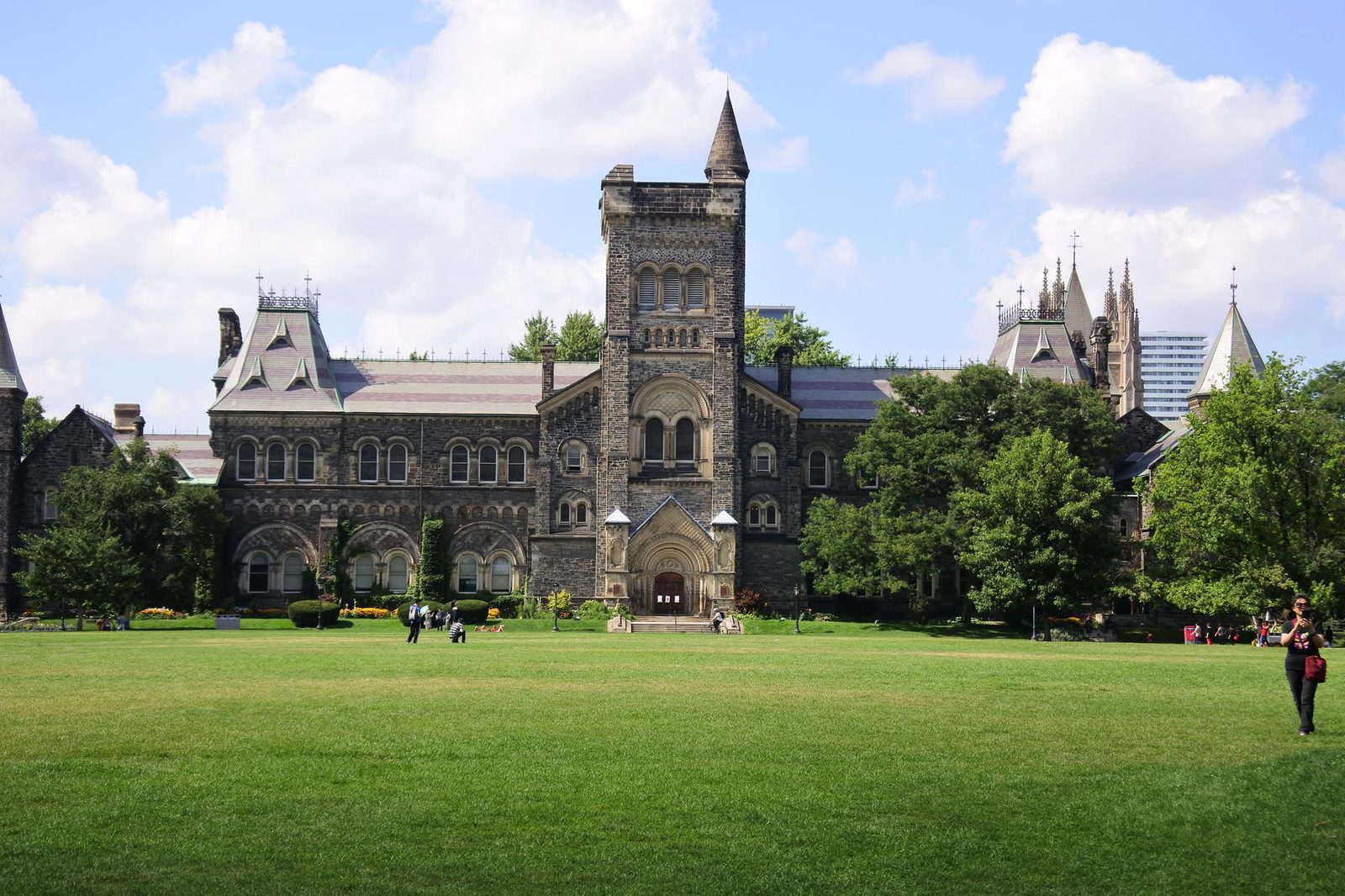
Image: "University College Lawn, University of Toronto, Canada" by Ken Eckert, CC BY-SA 4.0, via Wikimedia Commons. Cropped to fit.
#CanadaStudyPermit #StudyInCanada #CanadaStudentVisa #InternationalStudents #LoyalInstituteForEducation #Ambala