English-taught degrees, generous scholarships and one of Asia's most dynamic student cities - South Korea has quietly become a serious study destination for Indian students. If you are heading to a Korean university for a degree, the visa you need is the D-2 student visa, and you apply only after your university admits you. This guide puts the current rules in one place, with every figure from the Korean government's official Study in Korea portal, the Korea Immigration Service and the official Korea Visa Application Center in India, checked on 26 November 2026.
The visa in one view
The D-2 visa covers degree-seeking study at a Korean college or university: associate, bachelor's, master's and doctoral programs. Language courses and other non-degree programs use the D-4 instead. The D-2 is issued with a stay of up to 2 years at a time and can be extended inside Korea in line with your study period. Two cautions worth knowing up front: a visa is not a guarantee of entry (the immigration officer at the airport makes the final decision), and for any stay over 90 days you must complete alien registration at a local immigration office within 90 days of arriving.
| D-2 student visa | Current figure |
|---|---|
| Visa type | D-2 for degree programs (associate, bachelor's, master's, doctoral); D-4 for language and non-degree courses |
| Fee | About USD 60 for a single-entry visa for stays over 90 days, paid in INR at the mission's current rate, plus the KVAC service fee of INR 1,600 per application |
| Stay per issuance | Up to 2 years, extendable in Korea within your total study-period cap |
| Financial proof | Bank balance certificate of at least KRW 20 million per year (2024 standard), issued within 30 days of applying |
| India-specific extras | TB test certificate from a designated hospital; highest-education proof apostilled or consular-verified |
| Where to apply | Korea Visa Application Center (KVAC) covering your region; the form is on the Korea Visa Portal (visa.go.kr) |
| Part-time work | Not automatic - prohibited in principle until immigration grants advance part-time employment permission, simple labor only |
| After arrival | Alien registration within 90 days of entry for stays over 90 days |
How long you can stay
Each D-2 issuance allows a stay of up to 2 years, and you extend at a Korean immigration office as your course continues. Extensions sit inside an overall cap tied to your program level: 3 years for associate programs (4 if the program itself runs 3 years), 6 years for a bachelor's (7 for five-year programs), 5 years for a master's (6 for three-year programs) and 8 years for a doctorate (7 for five-year programs). For almost every student the cap sits well beyond the normal length of the degree.
The money you must show
The standard financial proof is a bank balance certificate showing at least KRW 20 million per year (the 2024 standard set by the Ministry of Justice). Three conditions matter: the certificate must be issued within 30 days of your application date, the balance must be in your own or your parents' account, and the amount must be written in KRW or USD only. If you use your parents' account, add family-relationship proof and copies of your parents' passports. Holders of the Korean government's GKS scholarship are exempt from financial proof.
Fees and where you apply from India
The official Study in Korea portal lists consular fees of approximately USD 40 for a single-entry visa for stays up to 90 days, USD 60 for a single-entry visa for stays over 90 days, USD 70 for a double-entry multiple visa and USD 90 for an unlimited multiple-entry visa. A degree student ordinarily needs the USD 60 single-entry category, paid in INR at the mission's current rate - the visa fee schedule was revised on 1 August 2026. On top of the consular fee, the Korea Visa Application Center charges a service fee of INR 1,600 per application, in effect from 25 August 2026.
Korea processes Indian applications through visa application centres by region. Northern India applies to the Embassy of Korea, New Delhi, through KVAC New Delhi or KVAC Kolkata (weekdays 9:00-13:00, no appointment needed). Central India applies to the Consulate General in Mumbai through the designated agency (9:00-15:00). Southern India applies to the Consulate General in Chennai through KVAC Chennai or KVAC Bengaluru (9:00-15:00, no appointment needed). Apply to the centre for the region where your passport was issued or where you live, and complete the application form on the Korea Visa Portal (visa.go.kr). Do not leave it late: the Consulate General in Chennai itself warns that applications can take longer than usual when demand is high, so apply as soon as your university issues the admission documents.
Documents Indians specifically need
Two India-specific requirements catch applicants off guard. First, the TB test certificate: India is on Korea's list of countries whose long-term visa applicants must submit a tuberculosis certificate issued by a designated hospital. You are exempt only if you have already submitted one to a Korean mission or immigration office since 2 March 2016. Second, the apostille or consular verification: India is also on the list of countries whose proof of highest education (your degree or school-leaving certificate) must be apostilled or verified by a Korean consulate before the visa application. Plan both early - each adds days or weeks to your timeline.
Working part-time as a student
Working on a D-2 visa is prohibited in principle. You may take a part-time job only after immigration grants advance part-time employment permission: sign an employment contract, have your university's international student advisor complete the part-time work confirmation form, and submit the application online or in person before you start. Permission covers simple labor only, and immigration sets the scope and permitted hours case by case, based on your level of study, attendance, grades and Korean proficiency, assessed against formal language tiers (TOPIK levels or the pre-evaluation scores). Manufacturing and construction work are restricted - manufacturing needs TOPIK level 4 or higher, construction is off limits, and unauthorized construction work leads to deportation - and teaching children at foreign-language facilities is not allowed. Working without permission can be punished. One honest note: official Korean guidance does not fix a single hours-per-week number for all students, because the hours come with your individual approval. Be wary of any website that quotes one number for everyone.
After graduation: the D-10-1 job-seeking visa
If you want to look for work in Korea after your degree, the D-10-1 job-seeking visa is granted in 6-month increments up to a maximum of 2 years. Graduates changing status from D-2 to D-10 for the first time are exempt from the usual financial proof (KRW 900,000 per month for 6 months).
Documents checklist
- Passport - original and a copy of the identity page.
- Photo - taken within the last 6 months.
- Application form - the integrated form completed on the Korea Visa Portal (visa.go.kr).
- Standard Admission Letter - the Certificate of Admission issued by your Korean university, plus a copy of the university's business registration.
- Financial proof - bank balance certificate of at least KRW 20 million per year, issued within 30 days, in your own or your parents' account, in KRW or USD notation.
- If parents' account - family-relationship proof and copies of your parents' passports.
- Education proof - your highest-education certificate, apostilled or consular-verified (India is on the required-country list).
- TB test certificate - from a designated hospital (India is on the required-country list; exempt if submitted to a Korean mission or immigration office since 2 March 2016).
- If a GKS scholar - scholarship proof, which replaces the financial documents.
Sources
- Study in Korea (NIIED, Korean government) - Visa and Stay (D-2 vs D-4, the 2-year issuance and total stay caps by degree level, the document list, USD fee schedule, alien registration within 90 days; checked 26 November 2026): studyinkorea.go.kr - Visa and Stay
- Study in Korea (NIIED) - Residence and Stay: Part-time Job (permission steps, simple-labor scope, language tiers, restricted sectors, penalties, D-10-1 job-seeking visa and its first-time financial exemption; checked 26 November 2026): studyinkorea.go.kr - Part-time Job
- Korea University - official D-2 visa application guidance (KRW 20 million financial proof and its 30-day validity, parents' account conditions, GKS exemption, the TB-certificate and apostille country lists that include India; checked 26 November 2026): info.korea.edu - D-2 visa guidance (PDF)
- Korea Immigration Service - Visa Navigator (D-2 stay of up to 2 years per issuance, part-time employment permission framework; checked 26 November 2026): immigration.go.kr - Visa Navigator (PDF)
- Korea Tourism Organization, New Delhi office - visa application routing (KVAC regions and hours for the Embassy in New Delhi and the Consulates in Mumbai and Chennai, no-appointment submissions, visa.go.kr portal; checked 26 November 2026): visitkorea.or.kr - Visa application in India
- Korea Visa Application Center, Chennai and Bengaluru - official notices (KVAC service fee of INR 1,600 per application from 25 August 2026, visa fee revision from 1 August 2026, high-demand processing warning; checked 26 November 2026): visaforkorea-ce.com - KVAC notices
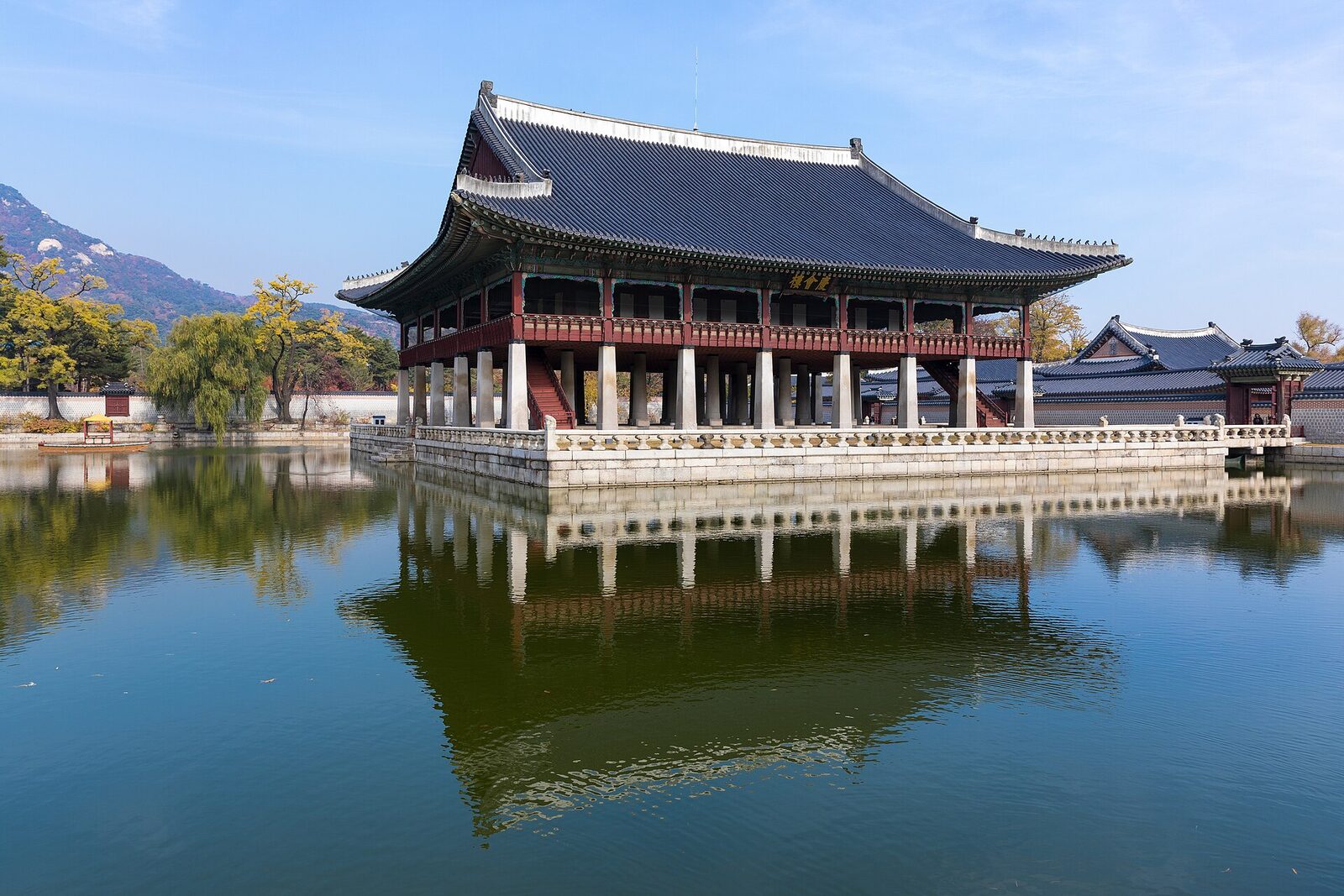
Image: "Gyeonghoeru (Royal Banquet Hall) at Gyeongbokgung Palace, Seoul" by Frank Schulenburg, CC BY-SA 4.0, via Wikimedia Commons. Cropped to fit.
#SouthKoreaStudentVisa #D2Visa #StudyInKorea #LoyalInstituteForEducation #Ambala